Understanding BISP eligibility is the single most important step for any household considering applying for support. The Benazir Income Support Programme uses a scientifically designed eligibility determination system that goes far beyond a simple income check. This article explains in detail exactly who qualifies for BISP in 2025, how eligibility is assessed, what criteria disqualify households, and how you can check your own eligibility status.
The Science Behind BISP Eligibility — Proxy Means Testing
BISP employs a methodology called Proxy Means Testing (PMT) to assess household poverty levels. This approach is used by social protection programs worldwide and is recommended by the World Bank as a rigorous targeting tool for middle and lower-income countries where income data is unreliable.
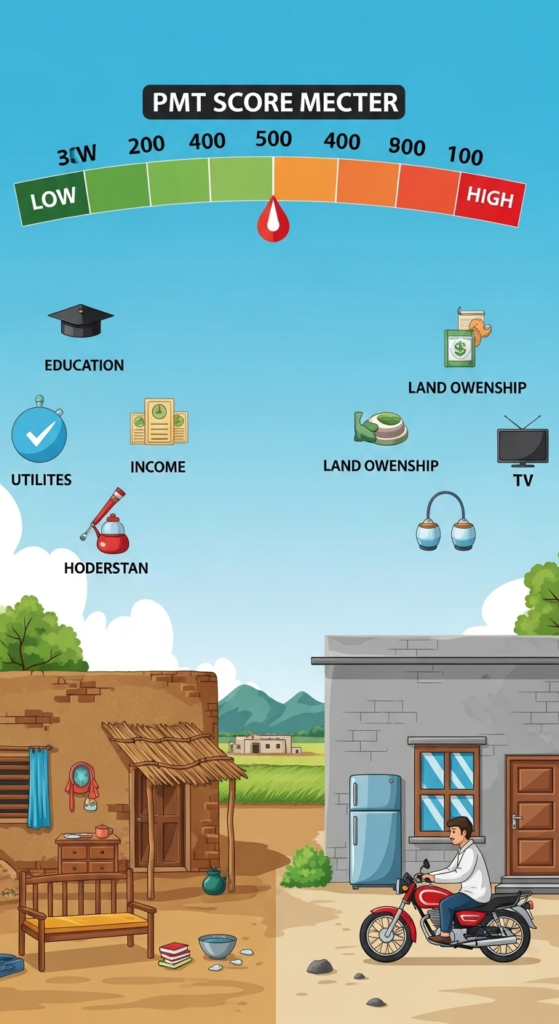
The core idea behind PMT is that certain observable household characteristics — things that trained enumerators can see and verify during a home visit — serve as reliable proxies for a household’s economic status. A household with concrete walls, a television, a refrigerator, and a motorcycle is likely better-off than a household in a mud-walled structure with no appliances and no vehicle, even if both households report similar incomes.
Key Proxy Indicators Used in BISP’s Poverty Scorecard
- Housing quality: Wall materials (mud/unbaked brick vs. concrete/brick), roof type, floor type.
- Utility access: Connection to electricity grid, natural gas, piped water supply.
- Sanitation: Type of toilet facility (open defecation vs. latrine vs. flush toilet).
- Asset ownership: Agricultural land (and how much), livestock ownership, motorized vehicles, major appliances.
- Household composition: Number of dependents, ratio of earners to dependents, number of school-age children.
- Education: Highest educational level attained by household head.
- Occupation: Type of work — casual daily wage labour scores differently from salaried employment.
- Geographic location: Rural vs. urban, and district-level poverty adjustments.
How the Poverty Score Is Calculated
Each indicator is assigned a weight in the PMT formula based on its statistical correlation with consumption poverty in Pakistan. The weights are derived from nationally representative household surveys. The scores from all indicators are combined into a single poverty score ranging from 0 to 100, where a lower score indicates greater poverty. Households below the programme’s cut-off score — which BISP periodically revises based on programme resources and poverty data — are classified as eligible.
The NSER Survey — How Eligibility Is Actually Determined
The National Socio-Economic Registry (NSER) is BISP’s database of household poverty assessments. Every household in BISP’s beneficiary registry has been assessed through an NSER survey conducted by a trained BISP enumerator who physically visited the home, filled out a structured questionnaire, and submitted the data to the BISP central system.
The NSER covers millions of households across Pakistan and is periodically updated through re-surveys. When you register for BISP and request inclusion, you are essentially requesting that your household be added to the NSER survey queue for assessment. Eligibility is determined by the survey results, not by BISP staff opinion or discretion.
Income Threshold — The Rs 25,000 Monthly Household Income Rule
While the PMT score is the primary eligibility determinant, households whose total monthly income exceeds approximately Rs 25,000 (from all sources combined, including casual wages, agriculture, remittances, and any other income) are generally ineligible for BISP regardless of their PMT score. This income threshold may be adjusted over time to account for inflation and changing economic conditions.
It is important to understand that household income in the PMT context means total income from all earners in the household, not just the primary earner. If your household has multiple earners whose combined income exceeds the threshold, the household would be assessed as above the eligibility cut-off.
Who Is Eligible — Special Categories
Women as Primary Beneficiaries
BISP is specifically designed to empower women. The programme mandates that the registered beneficiary within each eligible household must be an adult woman — typically the wife of the household head, or the female head of household in the case of widows, separated women, or women whose husbands are incapacitated. This policy is not merely administrative; it reflects extensive research showing that financial transfers to women have stronger impacts on household welfare, particularly children’s health and education outcomes, than transfers to men.
Widows and Female-Headed Households
Widow households — where a woman is the sole or primary caregiver with no male earner — receive priority consideration in BISP’s targeting. The death of a spouse is recognised as a major poverty shock, and BISP aims to provide immediate support to recently widowed women who suddenly find themselves responsible for household survival. Documentation such as a death certificate for the deceased husband strengthens a widow’s application.
Persons with Disabilities
Households where the primary earner has a severe disability that prevents productive employment are given additional consideration. The disability must be documented through a disability certificate issued by a recognised medical authority or the Social Welfare Department.
Elderly Women
Women above 60 years of age with no independent income source, no pension, and no able-bodied adult earner in the household are considered among BISP’s most vulnerable target group. Such households typically score very low on the PMT and are well within the eligibility range.
Transgender Individuals
BISP has made explicit provisions to include transgender (khawaja sira) individuals who are living in poverty and social marginalisation. Transgender individuals who meet the economic criteria can register and receive BISP support in their own name, recognising the particular vulnerability of this community in Pakistani society.
Religious Minorities
Non-Muslim minorities in Pakistan who meet the economic eligibility criteria are fully eligible for BISP support. The programme does not discriminate on the basis of religion and extends its poverty alleviation mandate to all Pakistani citizens regardless of faith.
Who Is NOT Eligible for BISP
Understanding disqualifying factors is as important as understanding qualifying ones. Your household is likely NOT eligible for BISP if:
- Any household member is a current or retired government employee receiving a salary or pension from federal, provincial, or local government.
- The household owns agricultural land exceeding a specified threshold (typically five to seven acres of irrigated land, though this varies by region).
- The household owns a motorized vehicle (car, jeep, or heavy transport) beyond a basic motorcycle.
- The household’s monthly income collectively exceeds Rs 25,000.
- The household resides in a pucca (fully constructed) home with significant assets.
- Any adult member holds a professional degree and is employed in a high-income profession.
Eligibility for Each BISP Sub-Program
Kafaalat Eligibility
Kafaalat eligibility is the base BISP eligibility — if your household qualifies for BISP overall, the female beneficiary automatically qualifies for the Kafaalat quarterly payment. There are no additional requirements beyond the standard BISP eligibility criteria.
Taleemi Wazaif Eligibility
To receive Taleemi Wazaif (education stipends), the household must first be a BISP Kafaalat beneficiary, and the child for whom stipend is claimed must be enrolled in a recognised school (government or private), must maintain a minimum attendance rate (typically 70%), and must be between the ages of 5-22 years. Children whose B-forms are linked to the mother’s BISP registration are eligible.
Nashonuma Eligibility
For Nashonuma (nutrition support), the beneficiary woman must be pregnant or a lactating mother with a child below 24 months of age, must be from a BISP-registered household, must reside in a district where Nashonuma has been rolled out (the program is being expanded nationally), and must be willing to attend regular health facility visits as required by the program.
Hunarmand Eligibility
Hunarmand skill training is available to women aged 16-45 from BISP beneficiary households. They must have at least basic literacy (though some courses are designed for non-literate participants), be willing to commit to the training schedule, and reside within a reasonable distance of an available training center.
How to Check Your BISP Eligibility
There are several ways to check whether your household is registered in BISP and eligible for payments.
- Send your 13-digit CNIC number (no dashes) to 8171 via SMS for an instant eligibility check.
- Visit the 8171 web portal online and enter your CNIC in the eligibility check field.
- Call the BISP helpline at 0800-26477 (toll-free) to speak with a customer service representative.
- Visit your nearest BISP tehsil office with your CNIC for an in-person status check.
Frequently Asked Questions — BISP Eligibility
Q: What is the income limit for BISP?
A: The general income threshold is Rs 25,000 per month for total household income from all sources. This is used alongside the PMT poverty scorecard to determine eligibility.
Q: Can a family member’s job disqualify us from BISP?
A: Yes. If any adult member of the household is a government employee or retiree receiving a pension, the entire household is disqualified from BISP.
Q: What if we own a small piece of land?
A: Small landholdings are considered in the PMT score but do not automatically disqualify you. The size and productivity of the land, along with all other household characteristics, are factored into your poverty score.
Q: How do I know what my BISP poverty score is?
A: You can request your PMT score information from your BISP district office. The score determines eligibility, and knowing it helps you understand why you were accepted or rejected.